

What Is Polki Jewellery? Natural Diamond, Moissanite, Kundan & Jadau Explained
By Jayati Sareen, Co-Founder of Ratnali
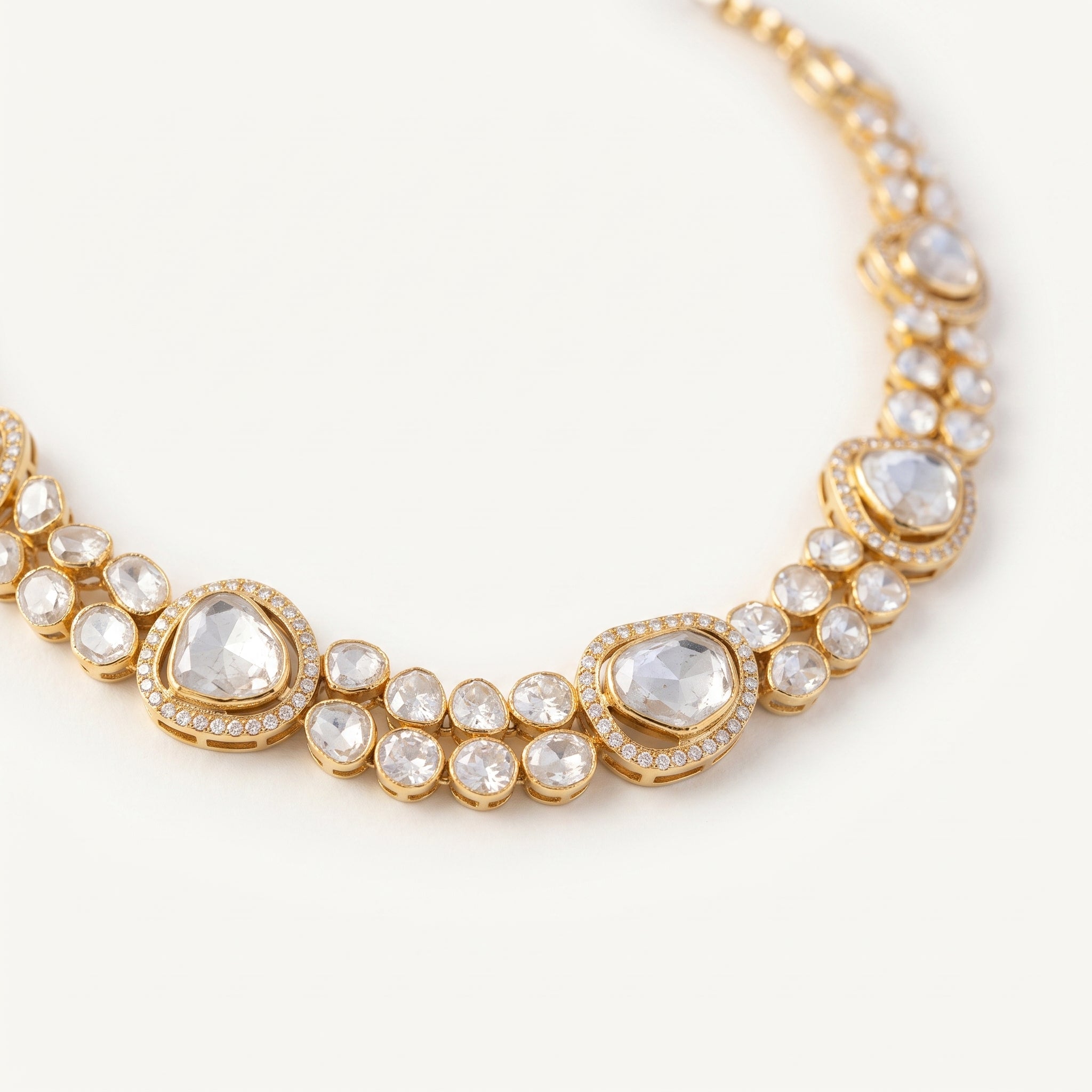
Polki, traditionally, means natural diamonds that are left uncut - or only very lightly shaped - and hand-set in gold. That's where the word comes from, and it's still the most special version of it.
But if you've started actually looking for Polki jewellery, you've probably also run into moissanite Polki, CVD Polki, Kundan and Jadau, all used slightly differently depending on who's selling it. It gets confusing really fast.
So here's the straight version.
Polki at a glance
| Term | What it actually means |
|---|---|
| Natural Diamond Polki | Natural diamond, left uncut or only lightly shaped, set in the traditional Polki style |
| CVD Polki | Lab-grown diamond, shaped to the same look |
| Moissanite Polki | Moissanite - a different stone entirely - cut and set to look like Polki |
| Kundan | A traditional gold-foil setting technique, most commonly used with glass or semi-precious stones |
| Jadau | The hand-setting craft behind both Polki and Kundan work |
So what is Polki jewellery, actually?
Traditional Polki uses diamonds that haven't been cut and faceted the way we usually think of a diamond. They're left close to their natural shape, sometimes with a small amount of shaping, but nothing like the precision-cut brilliance you'd see in a solitaire ring.
That's not a flaw. It's the point. Every Polki stone looks slightly different, and the whole piece ends up with a softer, more irregular kind of shine instead of that sharp, uniform sparkle. It's an older way of setting diamonds, and once you've seen it next to a modern cut stone, you can usually tell the difference at a glance.
Is Polki a real diamond?
Depends which Polki you mean, and this is genuinely worth checking before you buy anything, not just from us.
Natural Diamond Polki is the traditional version - real, natural diamond, mined and left uncut.
CVD Polki is diamond too, chemically identical to a mined stone, just grown in a lab (CVD stands for chemical vapour deposition, one of the standard methods used to grow diamonds). It's shaped afterwards to get that same raw Polki look, and it costs meaningfully less because there's no mining involved.
Moissanite Polki is not diamond, and this is where a lot of Polki jewellery gets sold without that being made clear. Moissanite is its own gemstone, with its own sparkle - actually brighter and more colourful than diamond, if you put them side by side. It's shaped and set the same way Polki traditionally is, which is why it gets called "Polki," but the stone itself is completely different.
We use moissanite in a large part of our own Polki range, and we'll always tell you when we have. It's a genuinely good option if you want the scale and craftsmanship of a big Polki piece without natural-diamond pricing - not a compromise, just a different choice.
What's the difference between Polki, Kundan and Jadau?
This trips almost everyone up, because the words get used interchangeably when they shouldn't be.
Polki describes the stone - uncut or lightly shaped diamond (or moissanite, styled the same way).
Kundan is a setting technique: fine, high-purity gold foil worked around a stone to hold it in place. In practice, Kundan jewellery is most often made with glass or semi-precious stones rather than diamond - that's the traditional distinction between "Kundan jewellery" and "Polki jewellery" even though they're set in a very similar way.
Jadau is the broader hand-setting craft behind both. It's the actual process - carving the gold base, working in the stones by hand, finishing the foil - that Polki and Kundan pieces are both built on.
So a single piece can genuinely be Polki, Jadau and have Kundan-style detailing on the same design. They're not competing terms. They're just describing different parts of the same piece.
How is it actually made?
By hand, and it takes a while.
Traditional Polki and Jadau jewellery is built up by hand: the stones are set into a prepared base and packed with a natural resin called lac while it's still workable, then fine gold foil is worked around the edge of every stone to lock it in and hide the join. On a detailed piece, that's several weeks of work from a small team of artisans, not a factory line.
Traditional fine pieces are often made in high-purity gold. Many of our own Moissanite Polki designs use the same hand-setting craft in silver with an 18K gold-plated finish, and are made to order by karigars we've worked with in India for years.

What about Kilwas, Syndicate and Zimbabwe Polki?
You'll come across these terms if you spend any time shopping for natural Diamond Polki, and it's worth being straightforward about what they actually are: trade terms used across parts of the Indian jewellery industry, not a formal or universally agreed grading system. Jewellers and suppliers don't always rank them the same way, and you'll find genuine disagreement even between fairly reputable sources on which sits above which.
What they're generally pointing at is differences in thickness, clarity, natural markings and source. Broadly:
- Kilwas is the most common and most affordable - thinner, and it's normal to see small natural marks or a faint line here and there.
- Syndicate is usually described as the cleanest and most lustrous, and it's the term most associated with heirloom-grade pieces.
- Zimbabwe refers to stones actually mined in Zimbabwe - thicker, generally untreated, and priced closer to Syndicate than the "middle tier" label suggests.
We'd rather you didn't buy a piece just because it's been called by one of these names. Ask what the stone actually is, whether it's been treated, what metal it's set in, and how it was made. Those answers tell you far more than the trade term does.
Natural Diamond Polki vs CVD Polki vs Moissanite Polki
| Natural Diamond Polki | CVD Polki | Moissanite Polki | |
|---|---|---|---|
| Stone | Natural diamond | Lab-grown diamond | Moissanite |
| Is it diamond? | Yes | Yes | No |
| Look | Soft, irregular, quietly luminous | Same Polki look, lab-grown | Brighter, more colourful sparkle |
| Investment | Highest | Below natural diamond, same chemistry | Most accessible |
| Best for | Heirloom and fine bridal pieces | Diamond Polki at a different price point | Statement and occasion pieces |
There's no single "right" answer here - it depends what you actually want from the piece. Someone buying a serious bridal set may want natural diamond specifically. Someone else wants the same look and craftsmanship for an event, without that level of spend. Both are valid. What matters is knowing which one you're actually getting.
Explore Moissanite Polki
- Classic Moissanite Polki Necklace
- Moissanite Polki Green Bead Fringe Necklace Set
- Emerald Polki Flower Stud Earrings
- Amazonite Moissanite Polki Bead Choker
Is Polki only for brides?
No - that's a common assumption, but it's not really true.
Full bridal sets tend to be large by design, which is why Polki gets associated with weddings so strongly. But a pair of Polki studs, a slim pendant, or a lighter necklace works just as well for a wedding guest, a dinner, a race day, or just a day you want to wear something with more presence. We'd rather help you find something you'll actually wear than tell you it has to be saved for one occasion.
What's Polki usually paired with?
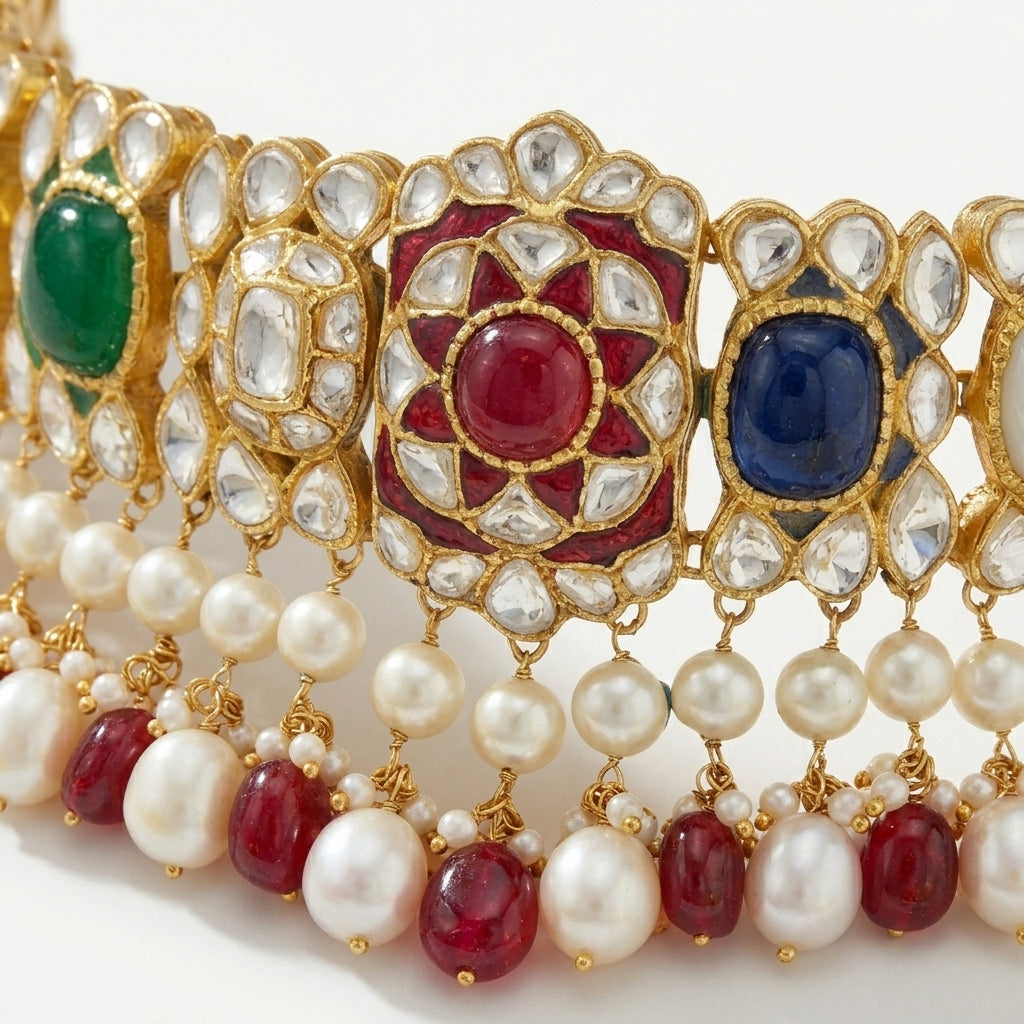
Emeralds, rubies and pearls, most often - they give the piece a hit of colour against the diamonds' quieter shine. You'll also often see Meenakari, the enamel work sometimes finished on the reverse of a piece, usually in deep green, red or blue. It's one of the details that makes traditional Polki pieces feel considered from every angle, not just from the front.
How do you look after it?
Gently, and away from moisture.
Keep it away from perfume, water and anything chemical - both the gold and the lac underneath can be affected over time. Store it somewhere dry, ideally on its own rather than tangled with other pieces. Clean it with a soft, dry cloth only - no soap, no soaking, and skip ultrasonic or steam cleaners unless a jeweller has told you your specific piece can handle it.
And check the care instructions for the actual piece you own. A natural Diamond Polki piece in high-purity gold and a Moissanite Polki piece in gold-plated silver don't need exactly the same care.
Can Polki jewellery last for generations?
Well-made Polki and Jadau pieces genuinely can, when they're looked after properly - but it depends on the piece, not just the fact that it's "Polki." The stone, the setting, the metal, the plating and how it was made all affect how it ages.
We'd rather be honest about that than let "heirloom quality" become a phrase that gets attached to anything labelled Polki. Know what your piece is actually made from, and it'll tell you how it's likely to hold up.
Buying Polki from Ratnali
Polki is one of those corners of jewellery where the terminology can make things sound far more complicated than they need to be.
Our approach is simple: we tell you plainly whether a piece is natural Diamond Polki, lab-grown diamond, or moissanite, along with the metal and finish. Most of our heritage designs are made to order with karigars we've worked with in India for years, and a lot of them can be adapted - in colour, scale, stones or detailing - if you have something specific in mind.
If you do, just tell us. Send an inspiration image, an outfit, or a rough idea, and we'll help you find something from the collection, adapt an existing design, or build something new through our Custom Design service.
Shop Polki → Custom Design Service →
Extraordinary jewellery, made personal.
Sources & further reading
- Gemological Institute of America (GIA) - research on Kundan, Polki and Jadau jewellery-making in Jaipur
- Gemological Institute of America (GIA) - education on lab-grown (CVD) diamonds and the distinction between diamond and moissanite
- The Metropolitan Museum of Art - collection notes on traditional Kundan-style gemstone setting and foiling techniques